

Tools & Resources
In addition to the Staebl Academy Learning Resources, Staebl provides Guides and Templates to enable you to communicate your design intent from Design to Demolition.
Latest Tools & Guides
Post-Construction Advocacy Guide
Design, Demolition and the Space In Between. Practical tools for navigating the “Pass the Parcel” problem in the built environment
Design, Demolition & the Space in Between
Thank you for attending the Australian Institute of Architects Continuing Professional Development seminar, Design, Demolition and the Space in Between.
I hope our session together has reinforced something many of us already know through experience: good architecture doesn't end when the drawings are issued, and it certainly doesn't end at practical completion.
Every project continues its journey through procurement, construction, handover, maintenance, refurbishment and, eventually, recovery or demolition. At every stage, responsibility is passed from one custodian to the next. Unless knowledge travels with that responsibility, design intent can gradually be lost. The resources on this page have been developed to help keep that conversation alive.
They are practical tools designed to support clearer communication, stronger supplier accountability, better product traceability, ongoing accessibility, sustainable decision-making and post-occupancy stewardship.
More importantly, they are intended to help create greater connectedness between the people who conceive a design and the many people who carry that design forward throughout the life of a building.
Please feel free to download, share, adapt and use these resources within your own practice, project teams and organisations. If they help start better conversations between architects, consultants, contractors, manufacturers, facility managers and asset owners, then they have achieved exactly what they were designed to do.
Together, we can help ensure that accessibility outcomes, sustainability commitments and design intent remain visible long after construction has finished.Thank you for being part of that conversation.
Dean Homicki
Founder, Stæbl Academy
Australian Institute of Architects (AIA) - CPD Course - Design, Demolition and the Space in Between. Join with Dean Homicki of Staebl Academy as he explores how accessibility outcomes, sustainability commitments and design intent can drift after handover and what architects can do to protect them. Discover practical approaches to supplier accountability, performance verification and post-occupancy documentation that can be applied immediately in practice.Resources
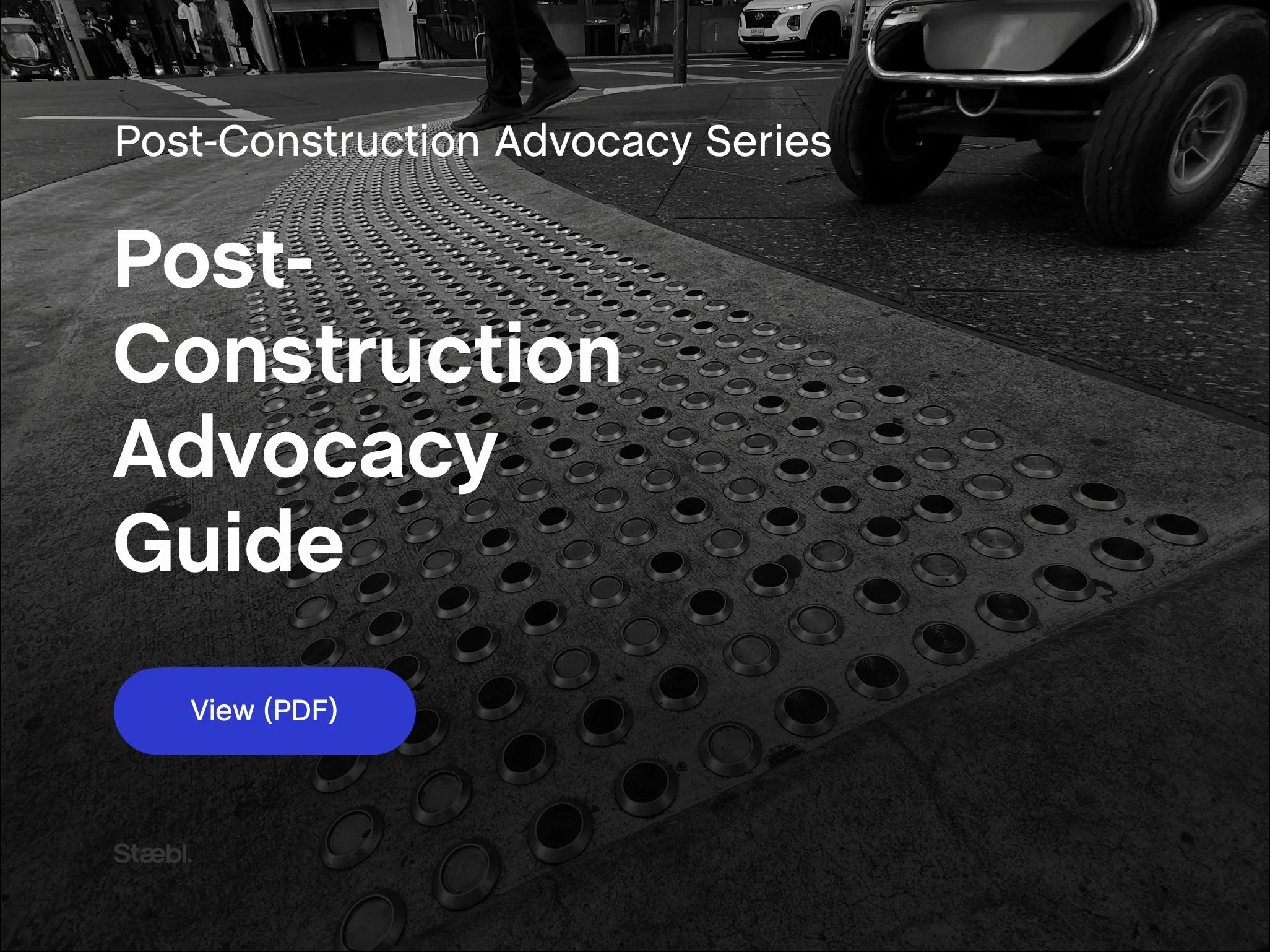
01. Post-Construction Advocacy Guide
Navigating the “Pass the Parcel” Problem in the Built Environment
How to use this handbook:
This guide explains how design intent can lose context as a project passes through many hands, and how documentation, supplier evidence, verification, maintenance knowledge and recovery planning can help protect the reason behind the work. It has been written for people who care about what happens after handover and want practical ways to help good design survive time, pressure, and change.
Best for:
Architects, designers, access consultants, project teams, asset custodians and built environment professionals seeking a practical framework for protecting design integrity through time.
02. Who is it For and Why is it Needed?
Prompting supplier evidence to remain visible throughout a project.
How to use this handbook:
A practical Post-Construction Advocacy document for architects, builders, access consultants, facility managers, asset owners and custodians who need supplier evidence to remain visible throughout a project.
It demonstrates why clear information is so valuable:
It helps request and record information about accessibility performance, materials, finishes, installation, maintenance, ethical procurement, warranty.
It also supports end-of-life recovery before a product, material or system is accepted into the design and specification.

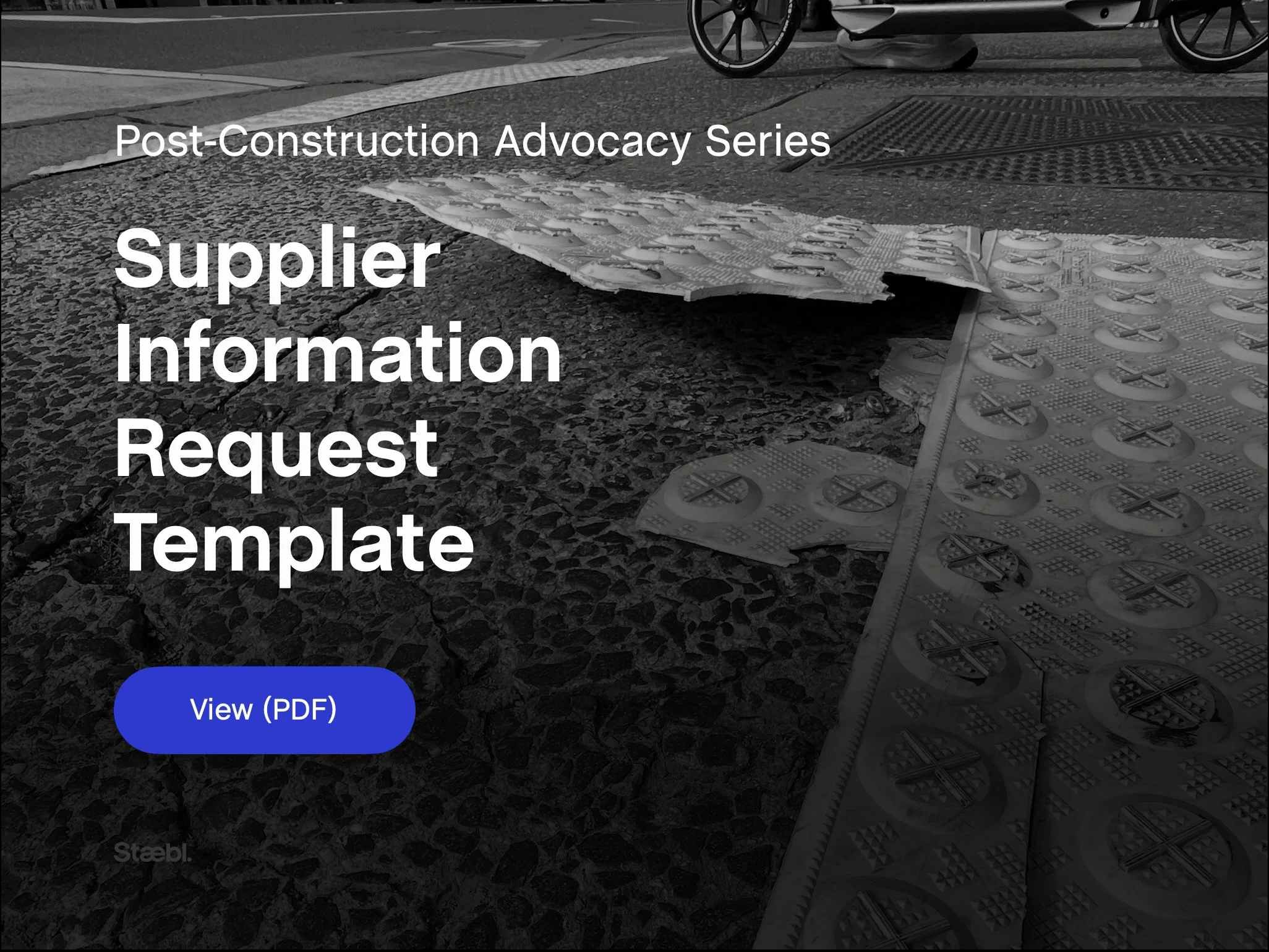
03. Supplier Information Request Template
Helping project evidence travel with the work
How to use this template:
Use this template to request supplier information before a product, material or system is considered or accepted into a project.
It supports clearer decisions around:
accessibility performance,
material and finish information,
installation requirements,
maintenance guidance,
ethical procurement,
warranty,
and, end-of-life material recovery.
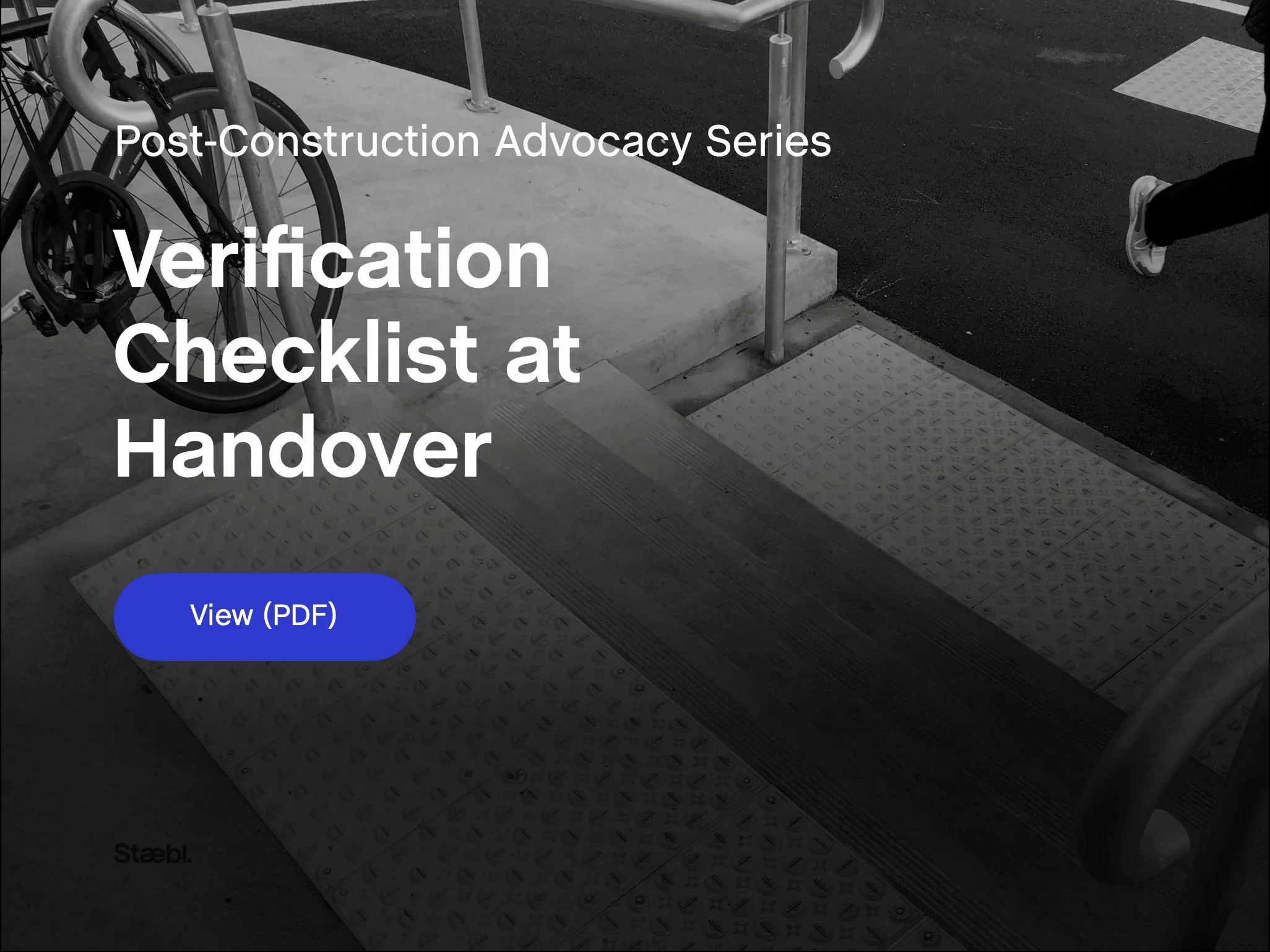
04. Verification Checklist
Checking design intent before the project is passed forward
How to use this checklist:
Use this checklist near practical completion, during site review or before handover to confirm whether key requirements remain visible in the built outcome.
It supports review of:
product identification,
accessibility performance,
luminance contrast,
slip resistance,
installation quality,
substitution records,
supplier evidence,
maintenance handover,
and, recovery information.
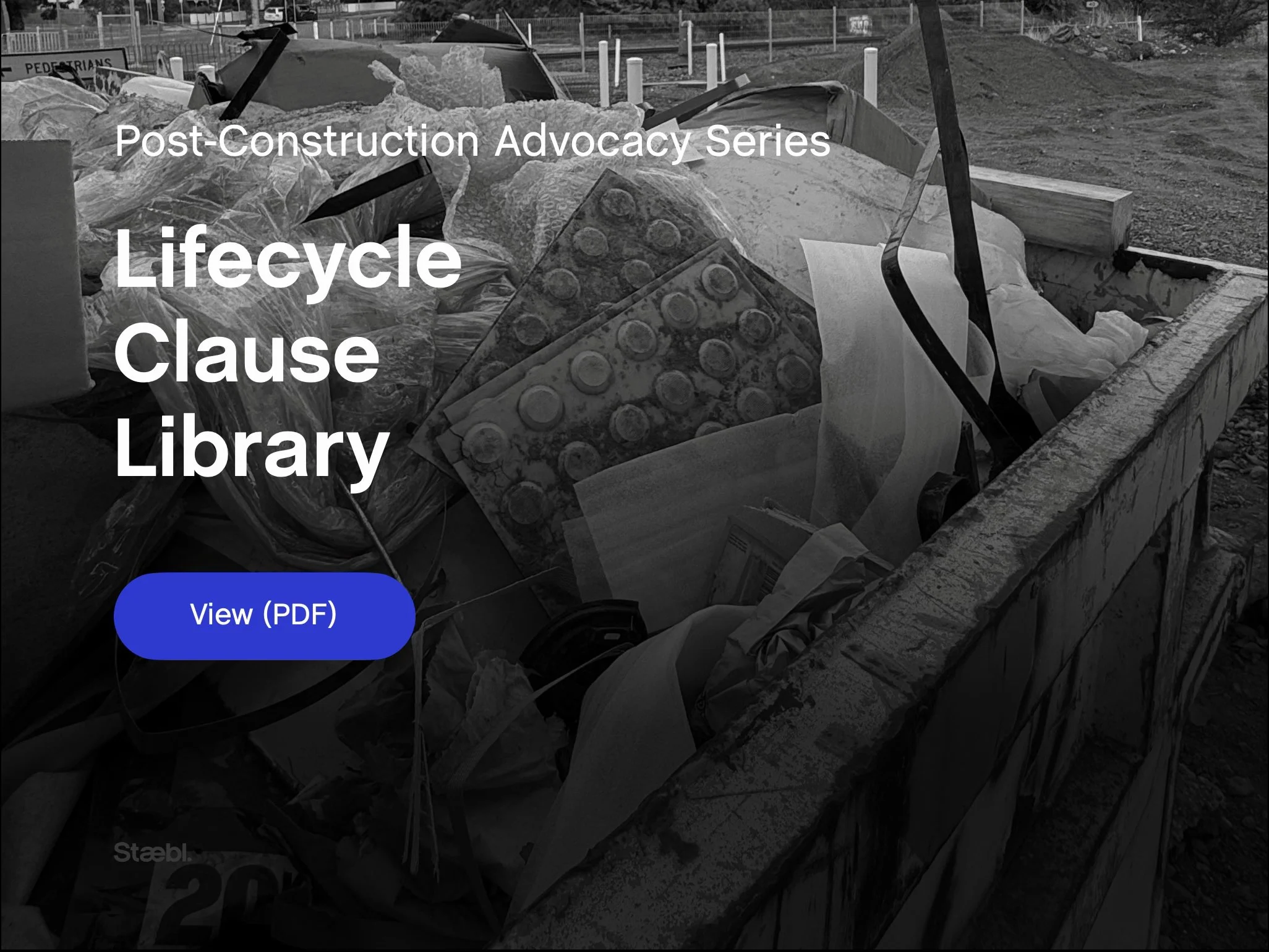
05. Lifecycle Clause Library
Example language for helping design intent travel through the project
How to use this template:
Use this clause library during documentation, specification writing, tender preparation or consultant coordination.
It includes example clauses for:
supplier evidence,
product substitution,
accessibility performance,
luminance contrast,
slip resistance,
installation,
maintenance handover,
replacement continuity,
ethical procurement,
and, end-of-life material recovery.
06. Post-Occupancy Review Template
Learning from the project after people begin using it
How to use this template:
Use this template after the occupation to review how the project performs in real use.
It supports reflection on:
original intent,
occupied movement,
accessibility performance,
material wear,
maintenance,
substitutions,
user feedback,
recovery readiness,
and lessons for future projects.
07. Environmental, Social and Governance (ESG): Operational Checklist for Custodians
Keeping responsibility visible after handover
How to use this checklist:
Use this checklist during asset handover, maintenance planning, procurement review, renewal works or demolition planning.
It supports custodians in reviewing:
handover knowledge,
accessibility continuity,
maintenance practices,
procurement consistency,
ethical supplier records,
environmental responsibility,
recovery pathways,
and public trust.
Appendix A
Terms & Definitions
This Appendix A - Terms & Definitions - provides definitions for the key terms used throughout the Post-Construction Advocacy Guide. These terms support a shared understanding of design continuity, accessibility performance, product stewardship, sustainable procurement, post-construction responsibility and material recovery. The definitions are intended to help designers, builders, asset owners, duty holders, facility managers, custodians and project teams use consistent language when making decisions from design to demolition:
Access Consultant: A professional who provides advice on accessibility requirements, user needs, design intent and compliance obligations within the built environment.
Accessibility Performance: The practical ability of a product, system or environment to support safe, dignified and equitable access for people, including people living with disability and people with low vision.
Asset Owner: The person, organisation or authority responsible for owning, managing or controlling a built asset and its installed products.
Built Environment: Buildings, public places, transport areas, external paths, internal circulation spaces and other constructed environments used by people.
Continuous Conformance: The ongoing ability of an installed product or system to remain understandable, inspectable, maintainable and aligned with its original compliance and accessibility intent over time.
Contrast: The visual difference between two surfaces or objects. In access design, contrast can help people identify important features such as stair edges, signage, TGSIs, doors, paths of travel and handrails.
Custodian: A person or organisation responsible for the care, records, maintenance, review, replacement or recovery decisions connected to an installed product.
Custodian®: Staebl’s product support and lifecycle stewardship program that integrates warranty support, maintenance guidance, field support, product records, retesting support and material recovery pathways.
Design Continuity: The preservation of the original design, accessibility, compliance, user experience and environmental intent of a product or system as the building changes over time.
Design Intent: The reason behind a product, system or design decision, including the performance, access, safety, compliance, durability, sustainability or user experience outcome it was selected to support.
Design Loop®: Staebl’s closed-loop product development and lifecycle planning model, based on the principle that what Staebl makes should be designed to be recovered, reused, remade or responsibly recycled.
Duty Holder: A person or organisation with responsibility for managing safety, access, compliance, maintenance or operational risk within a built environment.
End-of-Use: The point at which a product is removed from its first installed use but may still hold value for recovery, reuse, remaking, refurbishment or recycling.
Facility Manager: A person or organisation responsible for the operation, maintenance, safety and service performance of a building or site.
Free Resource: A guide, data sheet, report, checklist, learning module or educational tool made available to support better professional decision-making without creating unnecessary barriers to knowledge.
Light Reflectance Value: A measured value indicating how much visible light a surface reflects. LRV is used when assessing luminance contrast between products and surrounding surfaces.
Luminance Contrast: The measurable contrast between two surfaces, supporting visual detection for people with low vision and helping define important access features such as TGSIs, stair nosings or edges.
Maintenance: The regular cleaning, inspection, care, repair, and review of a product or system to ensure it continues to perform as intended.
Material Recovery: The process of collecting, returning, refurbishing, remaking or recycling a product or material so it is not unnecessarily sent to landfill.
Mobility and Orientation Product: A product designed to support safer movement, wayfinding, tactile detection, visual definition, hand support or access confidence within the built environment.
Pass the Parcel Problem: The loss of design intent, evidence, responsibility, or product knowledge as a project moves from design through procurement, construction, handover, maintenance, refurbishment, and demolition.
Post-Construction Advocacy: The practice of protecting the purpose, performance, evidence and recovery pathway of a product or system after construction has been completed.
Product Environmental Report: A product-specific document that discloses environmental, material, lifecycle and recovery information.
Product Stewardship: The responsible management of a product across its lifecycle, including design, manufacture, supply, installation, maintenance, use, replacement and recovery.
Replacement Decision: A decision to repair, remove, substitute or replace an installed product because of damage, wear, refurbishment, compliance review or changed site conditions.
Slip Resistance: The measured or classified ability of a pedestrian surface or product to reduce the risk of slipping in relevant use conditions.
Substrate: The surface or structural material into which a product is fixed or onto which a product is installed.
Substitution: The replacement of a specified or installed product with another product, often requiring assessment of performance, evidence, compatibility, compliance and recovery implications.
Sustainable Procurement: The process of considering environmental, social, governance, whole-of-life and circular economy outcomes when selecting products, services or suppliers.
Tactile Ground Surface Indicator: A raised tactile surface feature used to provide warning or directional information to people who are blind or have low vision.
Trade-In & Reunion: Staebl’s take-back and product recovery system that supports product return, recovery, refurbishment, remaking and responsible recycling.
Waste Remade®: Staebl’s material declaration and verification system identifies products or parts made from verified recycled material, including recycled aluminium.
White-Cane Detectable Cue: A tactile or physical feature that can be detected by a person using a white cane to support orientation, warning or movement decisions.
Appendix B
References
This Appendix B outlines the sources and reference frameworks used to inform the Post-Construction Advocacy Guide. These references support the guide’s focus on design continuity, post-construction responsibility, accessibility performance, sustainable procurement, product stewardship, transparent documentation and material recovery. Where page numbers or external document sections require final verification before publication, those references should be checked against the current published source before issue. Staebl’s core operational systems are referenced throughout this guide as practical examples of how product lifecycle responsibility can be supported through connected documentation, education, maintenance and recovery systems:
Design Loop® – Staebl’s closed-loop product development and lifecycle planning model aligns with whole-of-life costing, circular design, material recovery and long-term product accountability. Learn more: staebl.com/design-loop.
Waste Remade® – Staebl’s material declaration and verification system for recycled aluminium aligns with recycled content verification, environmental claims and transparent product documentation. Learn more: staebl.com/waste-remade
Custodian® – Staebl’s client assurance, maintenance and product lifecycle support model reinforces ongoing use, inspection, maintenance, recovery and lifecycle performance. Learn more: staebl.com/custodian.
Trade-In & Reunion – Staebl’s take-back and product recovery system supports end-of-use planning, landfill diversion, product recovery and material circularity. Learn more: staebl.com/trade-in-reunion.
Staebl Academy – Staebl’s learning platform supports capability building through CPD training, guides, product education, field observations and performance monitoring. Learn more: staebl.academy.
Footnotes
(1) Sustainable Procurement Guide, Department of Climate Change, Energy, the Environment and Water, Commonwealth of Australia, April 2024: pp. 7–11, 13–16, 22–24: Circular Economy, Climate Impact, Material Circularity, and Market Research Principles. Circular economy, climate impact, supplier transparency, material circularity, lifecycle thinking, procurement planning and contract management principles. Learn More: https://www.dcceew.gov.au/sites/default/files/documents/sustainable-procurement-guide-2024.pdf
(2) Green Star – Design & As Built v1.3, Mat-5 & Mat-6: including credits relevant to lifecycle impacts, responsible products, responsible sourcing and circular material outcomes. Learn More: https://new.gbca.org.au/green-star/rating-system/
(3) LEED v4.1 BD+C MR Credits: Materials and Resources credits, including lifecycle assessment, environmental product disclosure, sourcing of raw materials and construction waste management. Learn More https://www.usgbc.org/leed/v41
(4) National Construction Code (NCC 2022), (Section D4) and WCAG 2.1 Level AA: including accessibility provisions relevant to access to and within buildings. Learn More: NCC 2022 - Part D4 Access for people with a disability
(5) Disability Discrimination Act 1992 (Cth): Legislative framework supporting non-discrimination and equitable access for people with disability in Australia. Learn More: legislation.gov.au/C2004A04426/2018-04-12/
(6) Disability (Access to Premises – Buildings) Standards 2010: Requirements connected to accessible building work and access to premises. Learn More: legislation.gov.au/F2010L00668/latest/versions
(7) AS 1428.1: Design for Access and Mobility – General requirements for access – New building work. Applicable edition and clause references to be verified for each project. Learn More: store.standards.org.au/product/as-1428-1-2021
(8) AS/NZS 1428.4.1: Design for Access and Mobility – Means to assist the orientation of people with vision impairment – Tactile ground surface indicators. Applicable edition and clause references to be verified for each project. Learn More: store.standards.org.au/product/as-nzs-1428-4-1-2009
(9) AS/NZS 1428.4.1 Appendix E: Measurement of luminous reflectance and related luminance contrast assessment principles. Applicable edition and clause references to be verified for each project. Learn More: store.standards.org.au/product/as-nzs-1428-4-1-2009
(10) AS 4586: Slip resistance classification of new pedestrian surface materials. Used in relation to product slip resistance testing and classification. Learn More: store.standards.org.au/product/as-4586-2013
(11) AS 4663: Slip resistance measurement of existing pedestrian surfaces. Used in relation to the assessment of existing installed pedestrian surfaces, where applicable. Learn More: store.standards.org.au/product/as-4663-2013
(12) SA HB 198: Guide to the specification and testing of slip resistance of pedestrian surfaces. Used in relation to interpreting and applying slip resistance testing outcomes. Learn More: store.standards.org.au/product/sa-hb-198-2014
(13) AS 1657: Fixed platforms, walkways, stairways and ladders – Design, construction and installation. Applicable where the project context requires reference to fixed platforms, walkways, stairways or ladders. Learn More: store.standards.org.au/product/as-1657-2018
(14) AS 1735.5: Lifts, escalators and moving walks – Escalators and moving walks. Applicable where the project context includes escalator or travelator environments. Learn More: store.standards.org.au/product/as-1735-5-3-2019
(15) AS 1428.4.2:2018, Design for Access and Mobility: Wayfinding, supports accessible navigation by providing guidance for wayfinding systems that help people understand, orientate and move through the built environment with greater confidence. Learn More: standards.org.au AS1428-4-2-2018.
(16) Disability Standards for Accessible Public Transport 2002: Applicable where the product or installation is connected to public transport environments. Learn More: Transport-accessibility/transport-disability-standards
(17) ISO 14021: 2016/Amd 1:2021: Environmental labels and declarations – Self-declared environmental claims. Used to support responsible environmental claim language and recycled content declarations. Learn More: ISO 14021:2016/Amd 1:2021 and standards.org.au AS14021-2018
(18) ISO 14040 and ISO 14044: Environmental management – Life cycle assessment principles, framework, requirements and guidelines. Used to inform lifecycle thinking and environmental reporting structure. Learn More: ISO 14044:2006
(19) ISO 14067: Greenhouse gases – Carbon footprint of products – Requirements and guidelines for quantification. Used to inform product carbon footprint and environmental reporting approaches where applicable. Learn More: ISO 14067:2018
(20) Modern Slavery Act 2018 (Cth): Ethical sourcing, supply chain transparency and risk mitigation framework relevant to supplier responsibility and procurement governance. Learn More: Modern Slavery Act 2018
(21) Australian Packaging Covenant Organisation and National Packaging Targets: Packaging recyclability, material reduction and responsible packaging guidance. Final reference details to be verified before publication. Learn More: Australian Packaging Covenant Organisation
(22) Staebl Product Technical Data Sheets: Product-specific evidence for Staebl® Sight® TGSIs, Staebl® Knoll® Stair Edging & Trims and other Staebl mobility and orientation products, including material, finish, LRV, slip resistance, installation method, substrate compatibility, warranty and recovery information.
(23) Staebl Product Environmental Reports: Product-specific environmental, material, lifecycle and recovery documentation aligned with Design Loop®, Waste Remade®, Custodian® and Trade-In & Reunion.
(24) Staebl Supplier Environmental Sustainability Plan: Supplier environmental sustainability requirements, transparency expectations, material accountability and sustainable procurement alignment. Learn More: staebl.com/climate-2035
(25) Staebl Voluntary Modern Slavery Statement: Staebl’s documented approach to ethical sourcing, supplier responsibility and modern slavery risk awareness.
(26) Staebl Sustainable Packaging Strategy: Staebl’s documented commitment to responsible packaging, fibre-based material preference, plastic reduction and packaging alignment with circular design principles.
(27) Staebl Custodian Handbook: Product and installation lifecycle stewardship guidance for asset owners, duty holders, facility managers and custodians of the built environment.
(28) Staebl Post-Construction Advocacy Guide: Guidance supporting design continuity, access confidence and material recovery from design to demolition.
(29) Staebl Custodian® Sustainability Statement: Staebl’s service and recovery lifecycle framework integrates warranty, maintenance, field support and circular return. Learn more: staebl.com/custodian.
(30) Staebl Design Loop® Statement: Staebl’s closed-loop product lifecycle methodology and design responsibility framework. Learn more: staebl.com/design-loop.
(31) Staebl Trade-In & Reunion Program: Staebl’s end-of-use product return, recovery and material circularity pathway. Learn More: staebl.com/trade-in-reunion.
(32) Staebl Academy Resources: Educational guidance, CPD materials, field observations and product learning resources supporting accessibility knowledge and custodian confidence. Learn More: staebl.com/resources